
| (previously known as Procris subdolosa) PROCRIDINAE, ZYGAENIDAE, ZYGAENOIDEA | (donherbisonevans@yahoo.com) and Stella Crossley |

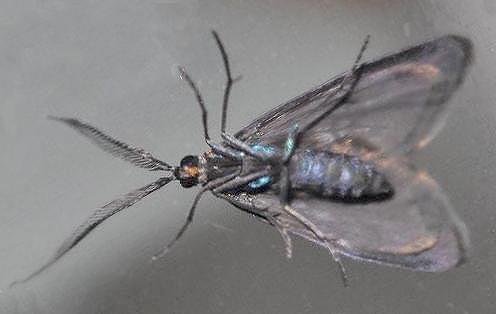
male, with sensilla on antennae opened
(Photo : courtesy of
Laura Levens, Upper Beaconsfield, Victoria)
|
| (previously known as Procris subdolosa) PROCRIDINAE, ZYGAENIDAE, ZYGAENOIDEA | (donherbisonevans@yahoo.com) and Stella Crossley |
male, with sensilla on antennae opened
(Photo : courtesy of
Laura Levens, Upper Beaconsfield, Victoria)
These Caterpillars are pale brown with a darker head with a few dark spots along each side of the abdomen. The bodies have sparse bristles. The caterpillars have been found feeding on

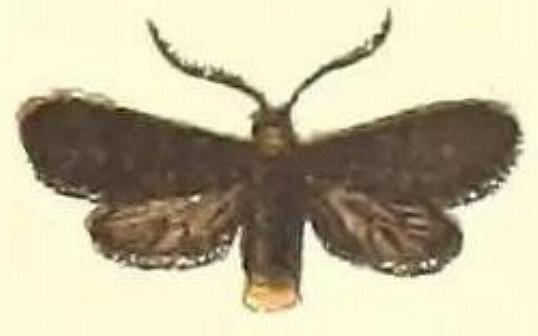
The adult moth is a metallic dark blue with a yellow prothorax. The moth has a wingspan of about 2 cms. The male moths have been observed to have to have the ability to fold or unfold the rami on their antennae.
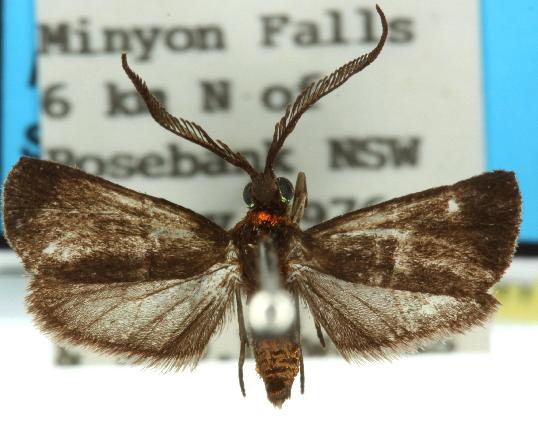
The eggs are pale yellow and elliptical. They are laid in irregular arrays on a foodplant leaf, and covered sparsely in hairs from the abdomen of the female.
The species has been found as the subspecies clara Tarmann 2005, in:
and the subspecies subdolosa Walker 1865, in:
Further Reading:
Ian F.B. Common,
Moths of Australia,
Melbourne University Press, 1990, p. 297.
Buck Richardson,
Tropical Queensland Wildlife from Dusk to Dawn Science and Art,
LeapFrogOz, Kuranda, 2015, p. 220.
Embrik Strand,
Tascina-Isocrambia, Indo-Australian Bombyces and Sphinges,
in Adalbert Seitz (ed.): The Macrolepidoptera of the World,
Stuttgart : Alfred Kernen Verlag,
Volume 10, (1933), Plate 1, fig h8.
Gerhard M. Tarmann,
Zygaenid moths of Australia,
CSIRO Publishing 2005, pp. 59, 66-67, 86-89, 91-96, 98-101, 128, pls. 13, 64.
Francis Walker,
Catalogue of Lepidoptera Heterocera,
List of the Specimens of Lepidopterous Insects in the Collection of the British Museum,
Part 31, Supplement part 1 (1865), p. 62.
 caterpillar |  butterflies |  Lepidoptera |  moths |  caterpillar |
(updated 22 December 2012, 12 July 2026)