
| LYMANTRIINAE, EREBIDAE, NOCTUOIDEA | (donherbisonevans@yahoo.com) and Stella Crossley |
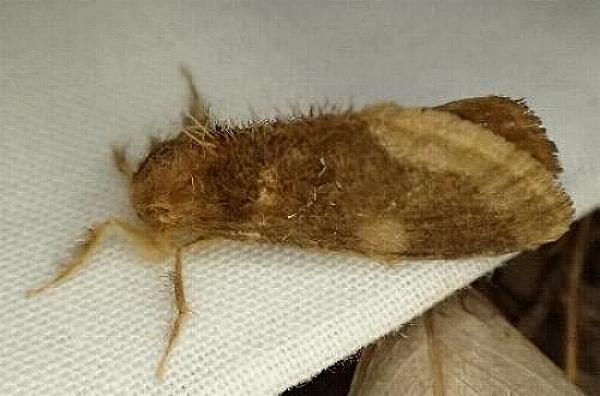
female
(Photo: courtesy of
Mark Hura,
Darwin, Northern Territory)
|
| LYMANTRIINAE, EREBIDAE, NOCTUOIDEA | (donherbisonevans@yahoo.com) and Stella Crossley |
female
(Photo: courtesy of
Mark Hura,
Darwin, Northern Territory)
The adult moths of this species are dimorphic.
The female has brown forewings,
each with a large vague pale spot near the middle,
and a vague pale band along the margin.
The hindwings of the female are pale brown,
darkening toward the margin.
The head and bulbous tail tuft are pale brown,
and the rest of the body is covered in dark brown scales.

The male has dark brown forewings, each with a yellow area near the base, a broken yellow band across the middle, and a patchy yellow submarginal arc. The hindwings of the male are yellow with a broad dark brown arc along the margin. The head and body are covered in dark brown scales, but the narrow tail tuft is yellowish..

The moths have a wingspan of about 4 cms.

The species has been found in
Further reading :
A. Jefferis Turner,
Revision of Australian Lepidoptera - Liparidae,
Proceedings of the Linnean Society of New South Wales,
Volume 45 (1921), p. 484. No. 21.
 caterpillar |  butterflies |  Lepidoptera |  moths |  caterpillar |
(written 13 November 2023, updated 17 May 2025)