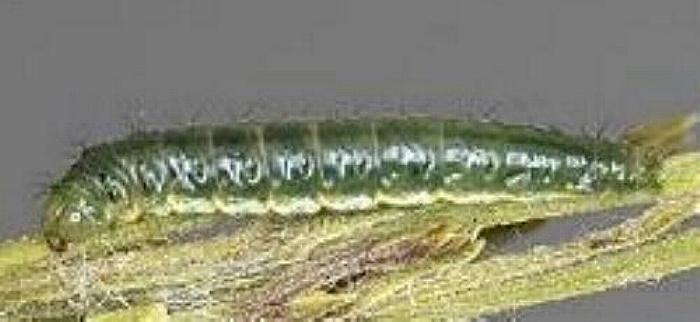

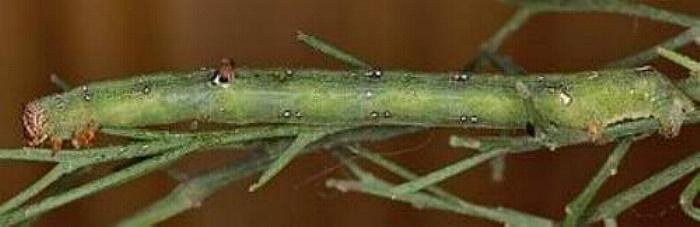
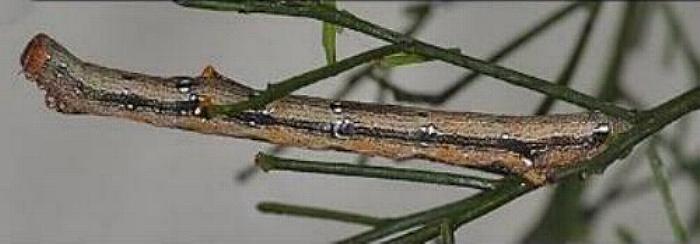
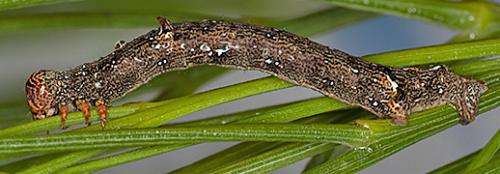
succesive instars
(Photos: courtesy of
Catherine Young-Byrne
and Elaine McDonald)
The first instar is green and slightly hairy.
The second is green, with thin wiggly dark lines.
The head is yellow and the legs are be tinged with pink.
The third instar is green with pairs of black-ringed white spots,
a pair of short horns on the back of the second segment,
and has a small yellow head with black markings
and yellow true legs.
The fourth instar is similar but is streaky grey.
The fifth instar is speckled dark grey, with a bigger head.
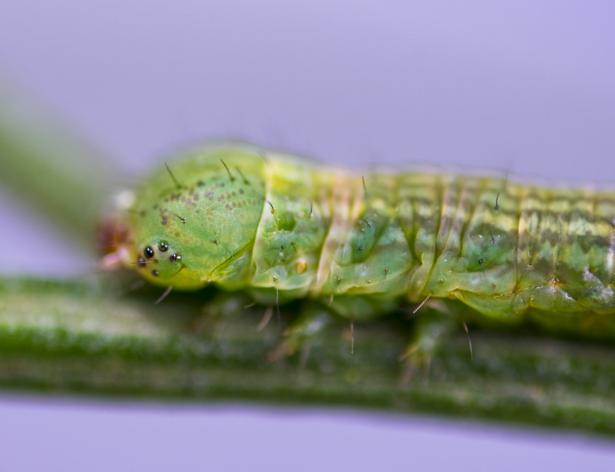
head of second instar, close up
(Photo: courtesy of
David Akers,
Won Wron, Victoria)
The caterpillar has been found on:
She Oaks ( Allocasuarina species,
CASUARINACEAE ), and
Australian Native Cherry ( Exocarpus cupressiformis,
SANTALACEAE ).
The caterpillar grows to a length of about 4.5 cms.
It pupates in a soil cell in a stiff dark brown cocoon,
which has a length of about 1.2 cms.
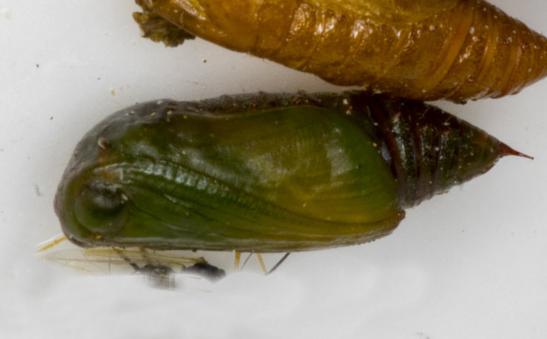
pupa
(Photo: courtesy of
David Akers,
Won Wron, Victoria)
The pupa inside the cocoon is initially green , turning brown as it matures.
The adult moth emerges after one to three weeks in summer.
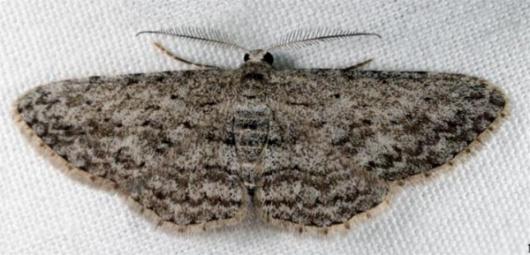
female, grey form
(Photo: courtesy of Marilyn Hewish,
Moths of Victoria: Part 7)
The female is grey or brown with an interesting wavy pattern,
and has a wingspan of typically 3 cms.
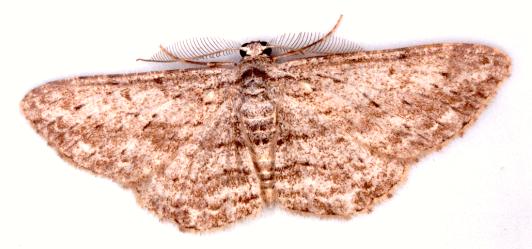
male, brown form
(Photo: courtesy of
Catherine J. Young)
The male is smaller, also grey or brown, with a wingspan typically
up to about 2.5 cms. Both sexes have
bipectinate antennae.
Beneath is uniformly grey with
a small discal
dot often on the female.
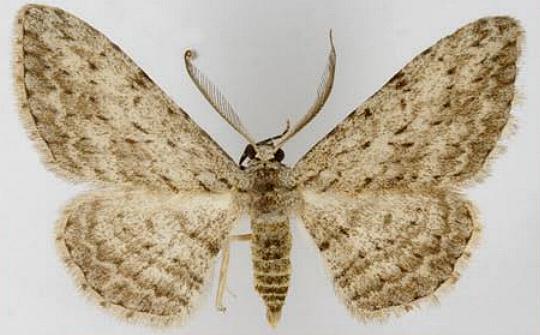
male
(Photo: courtesy of
Catherine J. Young)
The eggs are oval and orange with a microscopic set of
ridges along and around each egg.
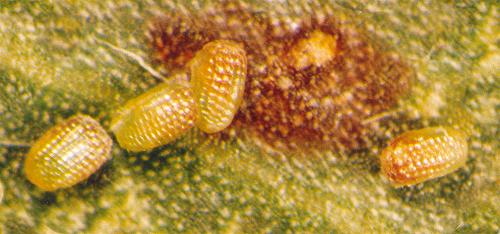
eggs, magnified
(Photo: courtesy of
Catherine J. Young)
The species has been found over much of eastern Australia, including:
Queensland,
New South Wales,
Australian Capital Territory,
Victoria,
Tasmania, and
South Australia.
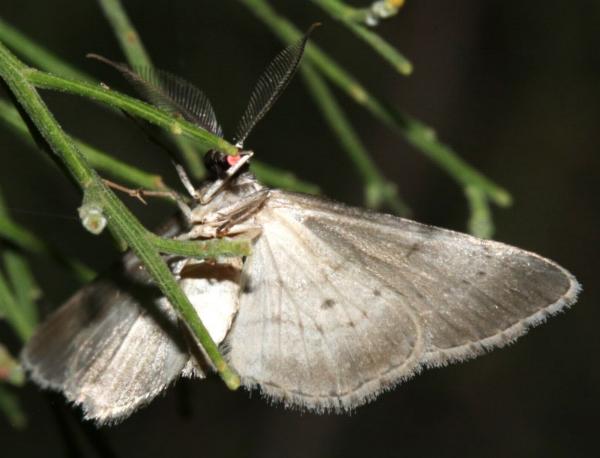
underside
(Photo: courtesy of
John Bromilow,
Mount Ainslie, Australian Capital Territory)
Further reading :
Marilyn Hewish,
Moths of Victoria: Part 7,
Bark Moths and Allies - GEOMETROIDEA (D),
Entomological Society of Victoria, 2016, pp. 18-19, 24-25.
Francis Walker,
Geometrites,
List of the Specimens of Lepidopterous Insects in the Collection of the British Museum,
Part 21 (1860), p. 392, No. 123.
(updated 24 July 2013, 2 May 2026)


